Carl Trahan
What Is a Shadow That It Must Be Captured?
2026.09.18 – 11.28
Since its invention, photography has fostered the illusion of capturing reality while transforming it into its own double. Carl Trahan’s art is inscribed in that interstice between the world and its representation. Deploying citations, photographs, castings and a video, the artist creates a tension between this desire to join with the Whole and the predatory aspect of the camera, which fixes the subject at the very moment it claims to possess it.
The artist’s research is informed by cosmic pessimism and his reflections on the spiritual crisis brought on by the modern age. Especially significant among his readings is La Photographie, le néant (1986), by Gastón Fernández Carrera. The author regards the medium of photography as the apogee of the West’s age-old mystical desire to dispense with the tangible envelope of the world and escape the unendurability of reality. Between light and darkness, the image becomes less a locus of truth, and more one of loss. What if, in seeking to capture shadows, we are in fact hoping to disappear along with them?
MICHEL HARDY-VALLÉE
The two Greek roots of the word “photography” are quite deceptive: they suggest that “light draws pictures.” In fact, it is shadows that create images–particles of silver, drops of ink, extinguished pixels or organic molecules that mask the whiteness of the supporting film, paper or display screen. Yes, we need a lighted subject to make a photograph, but we need areas of shadow for it to become a picture, as suggested by the medium’s historical association with printing processes (engraving, etching and lithography, among others). The “positives” and “negatives” that pioneer Henry Fox Talbot gave to the world are avatars of the ancient complementarity of figure and ground–like a hand that appears by blocking the stream of red ochre dust blown onto a rock face.
Blackness is Carl Trahan’s ally. A multidisciplinary artist with ties to Conceptualism, he is interested in the inexpressible, in the difficulty in grasping the essence of things. One constant across his work is the use of black both as a pictorial device and as a theme. In Traversing a Plane. After Bragdon (2021), a series of painted cherrywood panels represents the succession of shapes created by a cube (three-dimensional) crossing a plane (two-dimensional), a metaphor for the intangible passage of our physical existence through time (four-dimensional). In the corpus Sur les cendres des astres (2023), the artist explores the “nightside of thought,”1 using materials such as graphite, black marble, inkjet printing and charcoal to address concepts of pessimism, agnosticism and even mystical esotericism regarding our place in an alienating universe. The use of text and olfactory art attracts attention beyond the visual and underscores the viewer’s active participation in activating the work of art.
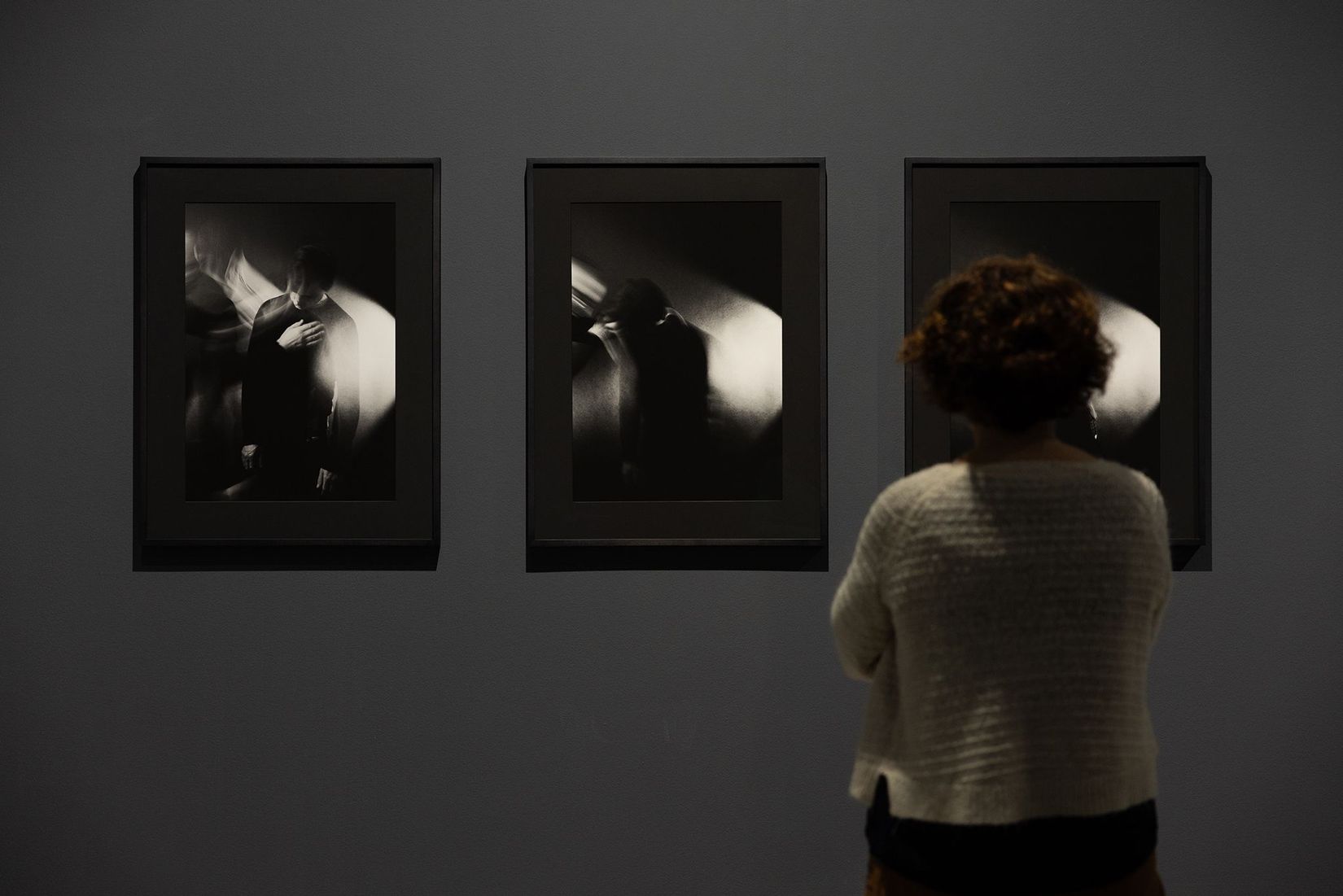
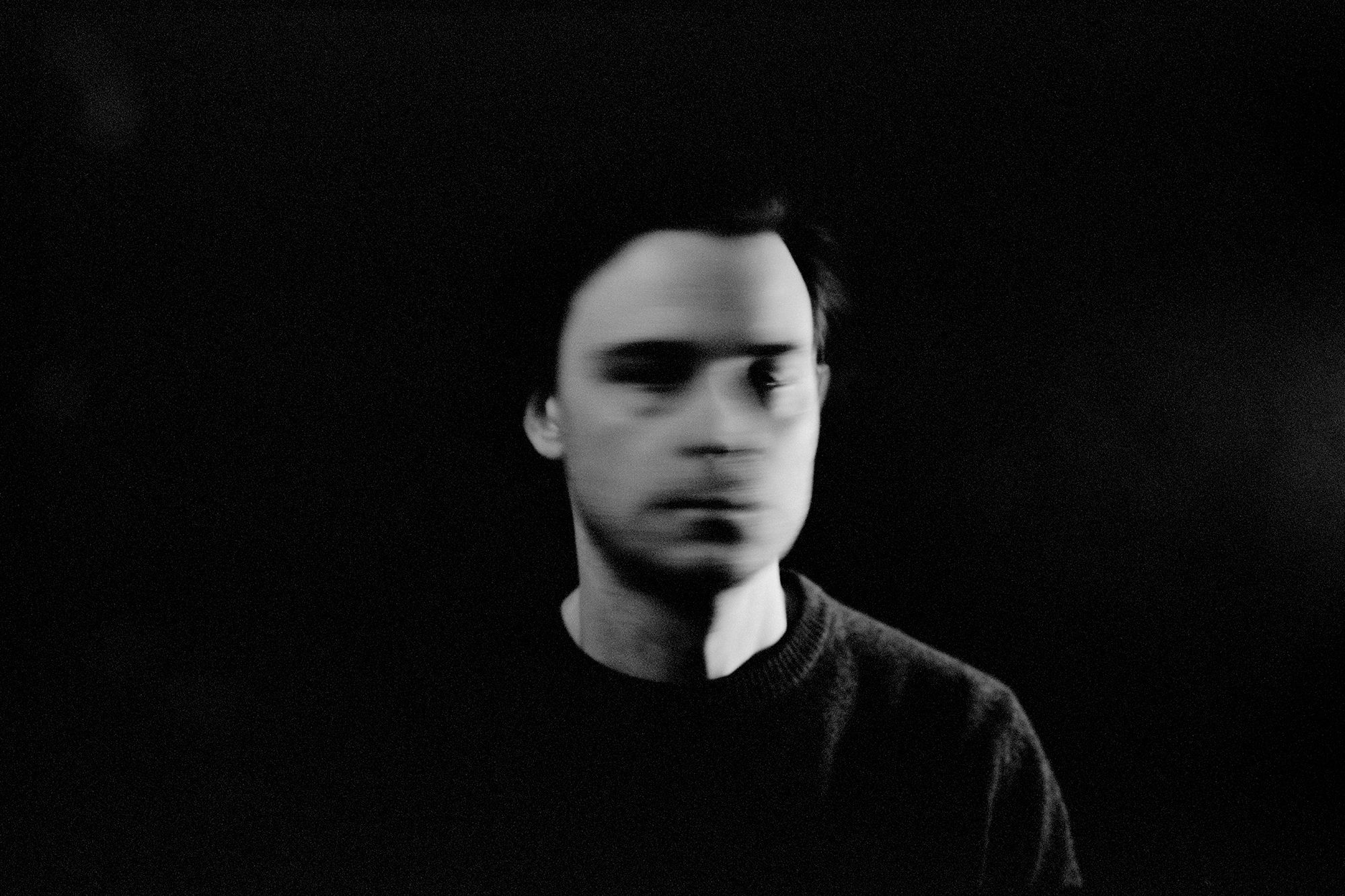
The analogue photos in this exhibition consist primarily of a black ground, against which flashes of light form, on the one hand, ambiguous images of subjects attempting to grasp something absent and, on the other, images that are blurry in appearance. Philosophers like Emmanuel Kant, prosaically, speak of phenomenon and noumenon–of surfaces and things-in-themselves. Our perception of the universe is one of surfaces, moulded by Cartesian doubt owing to the omnipresence of illusions and deceit.
Adherents to the mystical tradition, however–Jean of the Cross among them–view that same impossibility of knowing things unambiguously as a personal, even sensual experience, rather than a hindrance to the progress of reason. Though the idea of a god is fundamentally beyond understanding, the mystics embrace the feeling, even the certainty of being at home with divinity despite the absence of proof. This is apophatic theology, the “Via Negativa”: as with the strip of cellulose acetate exposed inside Trahan’s camera, we obtain an image of what divinity is not, rather than one of what it is.
Philosophers and mystics share this vision of a world in which fragile appearances conceal an immense void about which our experience revolves, even as our experience accommodates that void. The delicate paper casts Trahan made from hands and feet speak to this universe, thin as onionskin. We know for certain that the individuals they were cast from exist, even in their absence, because their distinguishing features cannot be falsified. As Oliver Wendell Holmes noted as early as 1859 about the stereoscope: “We have got the fruit of creation now, and need not trouble ourselves with the core.” Photography, he went on, would enable “an enormous collection of forms,” just as hunters in the Americas kill big game merely “for their skins.” He conceived of this massive repository of catalogued shapes as “something like a universal currency of these bank-notes, or promises to pay in solid substance [from] the great Bank of Nature.”2
But can we place our trust in the world. . . in trust, as it were? In his works, Trahan often references the ideas of Eugene Thacker, in particular that of the “world-without-us.” Evoking the cosmic horror of H.P. Lovecraft, Thacker seeks to deconstruct our egocentric vision of the world: with or without us, the planet continues to exist. Better (or worse?) still, it is profoundly indifferent not only to our existence, but to our sufferings and our joys. The text-based works in this exhibition echo that observation through sentences by turns anguished and paradoxical, like the subjects of some of the photographs, vulnerable to despair.
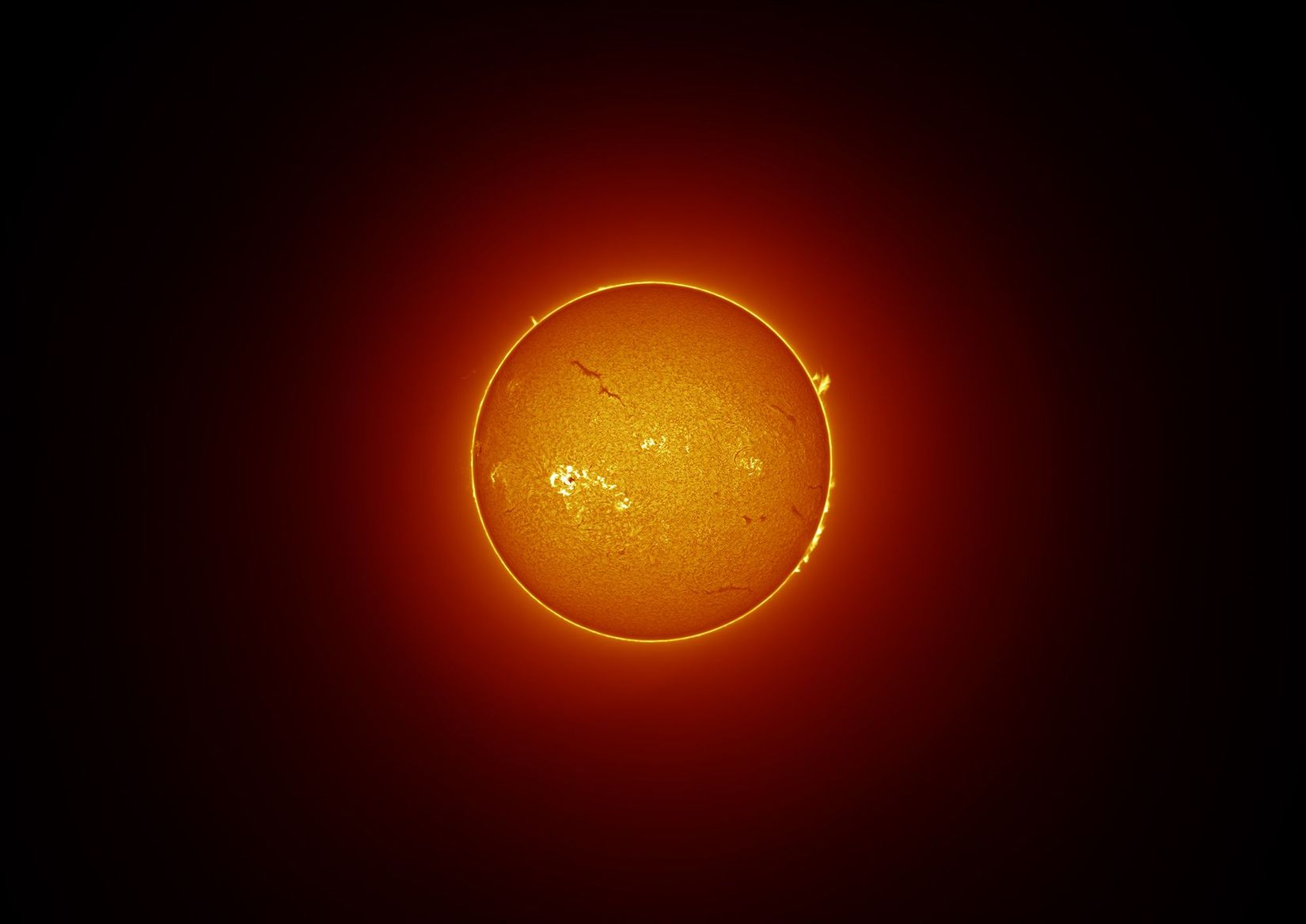
Throughout its young history, the nature of photography has been much debated–not least the relationship between the image and its subject. Expressions like traces, imprints, “mirror with a memory” or “the pencil of nature” reflect the belief that we have made sense of a medium of the world-without-us: nature taking pictures of itself. But in so doing, Trahan’s video reminds us, we let ourselves be led astray by the idea of an analogy. Images, in order to exist, must be inscribed within a ritual that we understand. They exist only with us. They must also offer us avenues to perception, as the philosopher Dominic McIver Lopes has noted.3 A picture, like a casting, is not “resemblant.” It is a prosthesis facilitating the recognition of objects, like the telescope view of the sun silently presiding over this exhibition. A sun that otherwise would be nothing but blinding light–a perfectly white photograph, devoid of meaning.