Infrastructures
Works from the n.b.k. Video-Forum collection
Part 1
2026.10.15 - 11.28
Between October 2026 and May 2027, Neuer Berliner Kunstverein (n.b.k.) and VOX will co-present three film programs featuring works from the n.b.k. Video-Forum collection.
What Keeps Us Together, What Draws Us Apart
Infrastructures of Movement
ANNA LENA SEISER
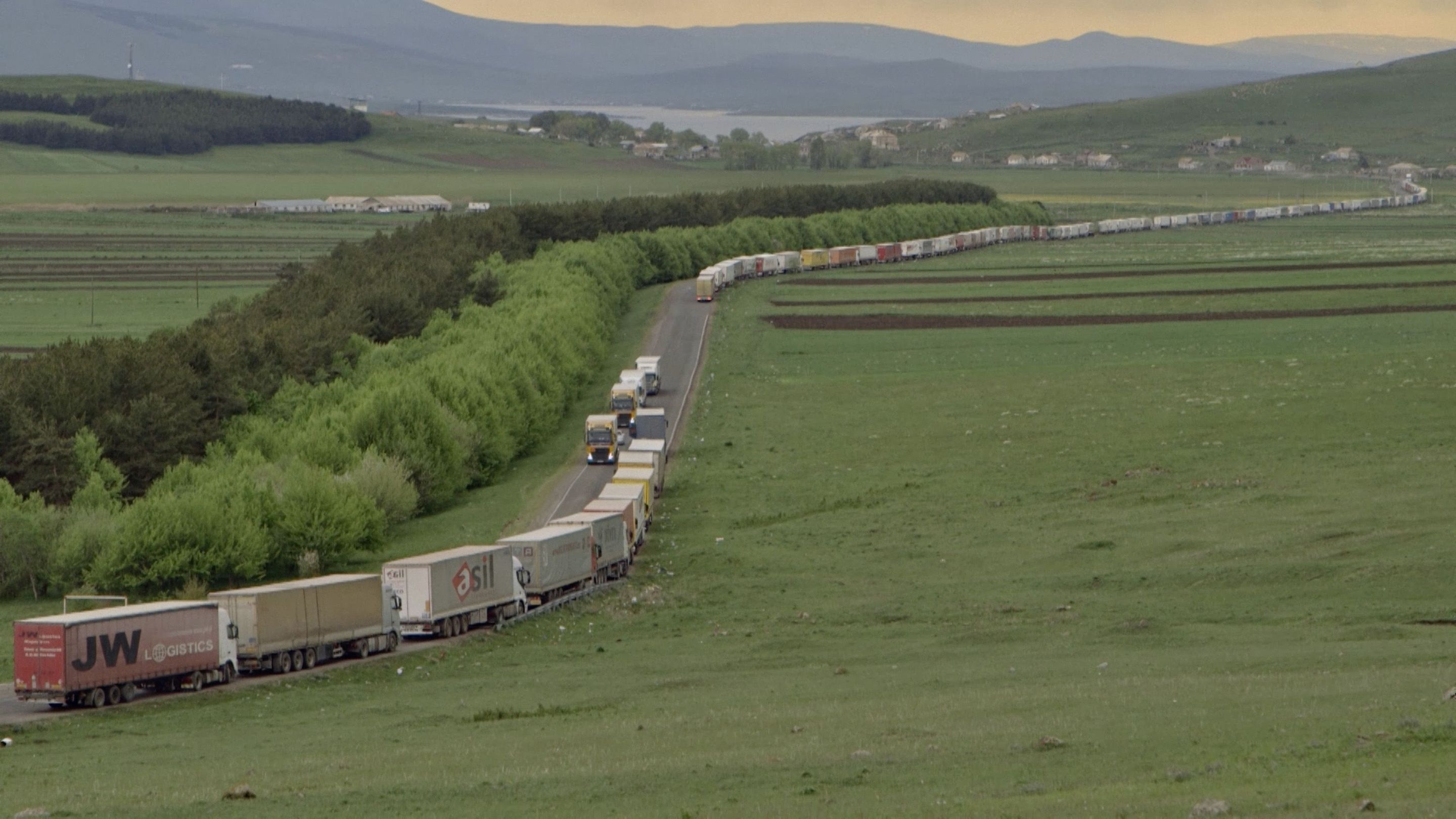
The first part of this program brings together works engaging with mobility and movement. At its centre are built structures–spaces, borders, transport networks–as well as legal and affective systems that connect territories and people while also serving as instruments of control, restricting movement and marking what counts as an outside. The works span several registers: from the intimate scale of bodies bound together in shared motion, to concrete infrastructures such as rail, aviation and shipping networks, which materialize political borders and histories of displacement, to the ideological power exercised through architecture and urban planning, which can declare people citizens, resources or security risks. Using a broad range of formal languages, all of the works examine who is permitted to move freely, who is held back, and how this distinction is enforced.
Infrastructures
From global transport networks to server farms, supply chains, healthcare systems, judiciaries, borders and digital platforms, infrastructures are omnipresent. In recent years–marked by overlapping political, ecological and economic crises–critical engagement with them has intensified. For it is only in moments of disruption and failure that these ramified systems, and our essential dependence on them, manifest themselves. Whether in physical networks, background algorithms or culturally codified gender roles, questions of regulated availability of resources, mobility, connectivity, and individual and national security are more pressing than ever.
Contemporary infrastructures shape our lives in manifold ways. They are concrete and intangible ordering systems that produce and organize a given space or group–from the family to urban structures to entire territories. They are what holds us together beneath the surface, allowing us to relate to one another and to the world, and to situate ourselves within the social fabric.
Whoever controls infrastructures is endowed with the power to inform perception, determine participation and movement and–conversely–to withhold them. The organization of a space generates a gradient of dependency and benefit, as it involves the creation of an outside, the establishment of distinctions, and the setting of inequalities between bodies, communities and geographic regions. That the availability of certain infrastructures is itself a privilege is something many people are reminded of daily, while others remain scarcely or never aware of it.
The screening series Infrastructures takes this concept as a starting point to present a selection of historical and contemporary video art works from the n.b.k. Video-Forum collection that engage with the visible and invisible underpinnings running through every sphere of our existence. Who is connected, who is in control, and how? Who has access to certain places and livelihoods, and who is cut off from them? What possibilities exist to transform given infrastructures and to reduce dependencies and inequalities?
The artistic contributions are grouped into three thematic strands: questions of mobility and movement, questions of media-shaped perception, and questions of social agency and norms that configure our everyday lives and, ultimately, our ways of living.
The artists employ performative and essayistic approaches to enquire into existing structures, reflect on their social repercussions or point to alternative modes within established systems. Some proceed playfully, while others adopt a documentary perspective. Not least, the works negotiate the foundations of art itself–and its role in rendering infrastructures visible.
A joint project by n.b.k. Video-Forum (Berlin) and VOX, with the support of the Goethe-Institut Montreal and the Conseil des arts et des lettres du Québec.
The n.b.k. Video-Forum collection
Founded in 1971 as an artists’ initiative, the Video-Forum of Neuer Berliner Kunstverein is the oldest and, with over 1,800 works, one of the major public video art collections in Germany and Europe. The focal points of the collection are Fluxus, feminist video, the historical and contemporary situation of video art in Berlin, video art from Eastern Europe and approaches reflecting on the media. The collection has been continually expanded through co-productions and annual acquisitions.
Neuer Berliner Kunstverein is supported by the Kriket Foundation. Neuer Berliner Kunstverein n.b.k. gGmbH is funded by the Berlin Senate Department for Culture and Social Cohesion.