Parastoo Anoushahpour, Faraz Anoushahpour and Ryan Ferko
One’s Own Eyes
2026.04.24 – 06.20
Since 2013, the trio has honed a shared art practice in which archives and image-making apparatuses function as fields of play, tools of subversion, and initiators of encounters as they examine territories and their narratives. These geographical autopsies rely on bodies that obstruct the camera and manipulations of film stock that disrupt readability—revealing, from one frame to the next, relational nodes linking the sites observed to the construction of national identities, extractivism, and the ensuing migrations.
One’s Own Eyes visits several regions of Iran, tracing the paths of two filmmakers who documented the same landscapes: Albert Lamorisse and Jacques Madvo. The artists marshal excerpts from their films along with sound recordings and photographs, while deploying playful and speculative strategies to generate multiple perspectives on these sites, time periods, and spectral presences.
On the Other Side of the Wind
ANTOINE THIRION
The exhibition by Parastoo Anoushahpour, Faraz Anoushahpour and Ryan Ferko at VOX, centre de l’image contemporaine comprises a large installation along with a standalone film, covering a meaningful span of their collaboration begun in 2013.
Both pieces evoke places marked by extractivism, displacement, and antagonistic imaginaries, through a multiplicity of historical and fictional narratives, of which some are drawn from film history. In Lover’s Wind, which occupies the central space of the main gallery, the place is the Karaj Dam near Tehran, where filmmaker Albert Lamorisse was killed when his helicopter struck high-tension lines (the aircraft’s putative carcass remains suspended there, above the lake). In Chooka, screening in a separate room, it is a village in northern Iran where Bahram Beyzaie made two major films, and which appeared in another film, made by Armenian director Jacques Madvo in the 1970s, when a paper factory employing Canadian and U.S. workers was being established nearby.
Each work presents landscapes marked by an imposed outside gaze. From expatriate communities of North Americans to a French filmmaker’s lyrical vision of Iran, they reveal imaginaries intrinsically linked to power structures. These relations are crystallized in the figure of Lamorisse. Invited by the shah in the late 1960s to make a film in Iran, he conceived of Le vent des amoureux: a fable narrated by a benevolent Persian wind that protects a village from the destructive wrath of its brother. This conceit allowed Lamorisse to shoot the entire film from a helicopter, perpetuating a fascination for weightlessness evident in previous works that depicted a child’s red balloon, a hot-air balloon, and a pair of false feathered wings. The director—perhaps less well known for his skills as an inventor—designed a rig, dubbed Hélivision, that facilitated stable aerial shots.
That quest for heights, of course, was fraught with ideological connotations far less benign than Lamorisse’s narratives would suggest. François Truffaut once criticized Lamorisse for the decorative poetry of The Red Balloon (1956), proffering this advice: “it’s better to tell a serious story lightly than to relate light matters gravely.”1 In the end, ironically, gravity did indeed vanquish Lamorisse’s aerial fantasies. His Iranian project was itself a victim of contradictory expectations: while the filmmaker embraced a lyrical vision, the shah rejected the first version of the film as too folkloric and, insistent upon images more in accordance with his idea of a modern, industrialized Iran, provided a list of locations for further shooting.
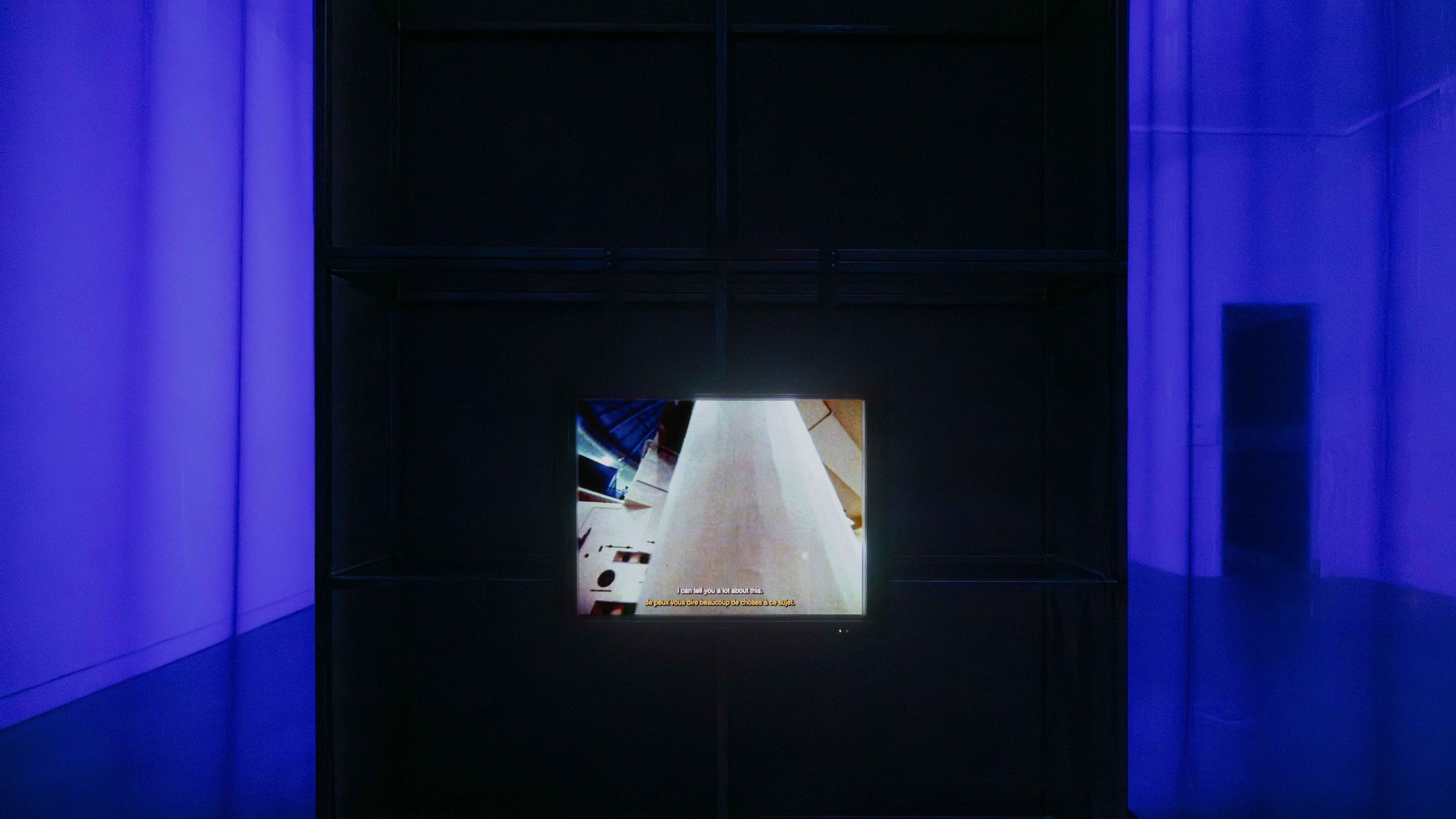
Lamorisse’s death during that second round of shooting irreversibly fractured the project. Two divergent films resulted: one, completed years later by members of Lamorisse’s family based on his notes, was nominated for an Academy Award in 1978; the other, assembled by an Iranian crew using recovered footage and including an official preface by the Iranian state, has circulated as a “postscript” to the main film. Instead of reconciling the two versions, the installation materializes the scission by producing two films of equal length, one of which is screened inside a tower-shaped structure, and the other, on one of its faces.
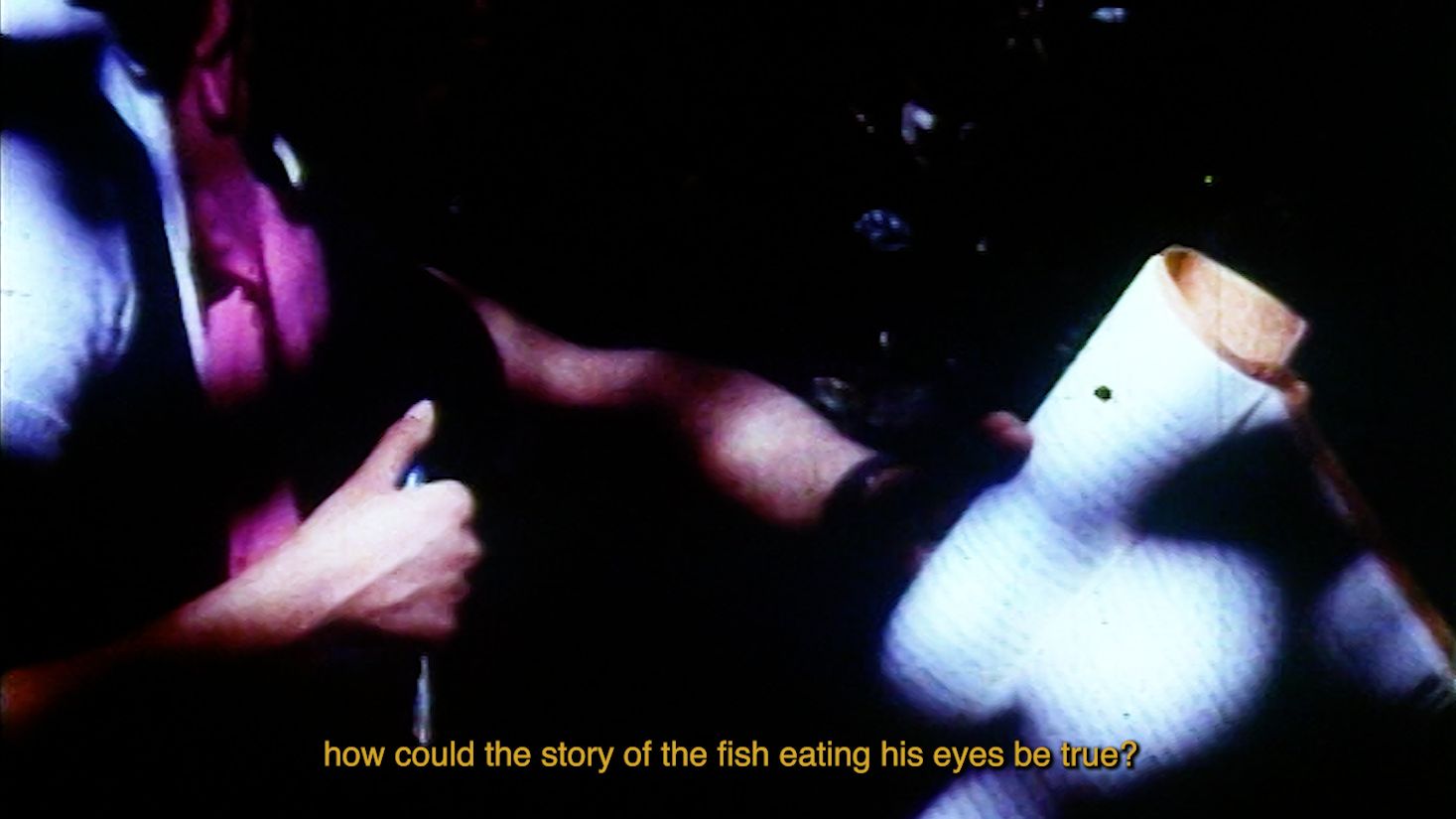
On the inside, Postscript stretches the six minutes of recovered footage into half an hour’s running time, soundtracked by a recording of a phone conversation between Faraz Anoushahpour and an archivist from the Iranian National Cinematheque. Their dialogue generates an accumulation of uncertainties—contradictory accounts, fragmented versions, speculative interpretations—that thwart any narrative resolution. The document dissolves into the doubt enveloping it, even as it attests to the importance of this story in Iranians’ collective memory. On the outside, Lovers’ Wind is screened in a vertical format imitating a strip of film stock. The film recomposes Lamorisse’s presence through biographical fragments, reconstitutions, and objects placed back into circulation. His words, both real and imagined, are voiced by an actor, while various elements of his films reappear, both within Lovers’ Wind and in images on video monitors distributed around the gallery space.
The artists wield these strategies not merely to reintroduce the figure of Lamorisse: they reincorporate his essence in the very materiality of the landscapes that his inventions overflew. Countering a romanticized vision of winds blowing freely across borders, they rebalance the relationships between gravity and lightness, constructing a figure linked to modes of destruction. The central sequence of Lovers’ Wind is structured around Risk, the famous board game invented by Lamorisse, the avowed goal of which is world domination by colonization. The helicopter, which for the filmmaker was a tool of aesthetic liberation, also reprises its role as an instrument of violence, as the thudding of its rotors blends with the mechanical rhythm of film unspooling, eventually arriving at a fatal stop where the material and political boundaries of cinema coincide.
Chooka extends the artists’ investigation, via the legacies of industrial and cinematic histories. Visiting a house where Beyzaie stayed during the making of his films The Stranger and The Fog (1974) and Bashu, the Little Stranger (1989), the trio meet its current occupants, still employed at the paper factory long after the departure of its foreign workers in the wake of the 1979 revolution. The landscape offers up a palimpsest of temporalities: local (hi)stories intersect with transnational labour, state transformations, and the memory of cinema. The presence of films shot decades earlier persists, like a trace inscribed in lived experience.
Parastoo Anoushahpour, Faraz Anoushahpour, and Ryan Ferko lay bare tensions rather than producing a unified vision. Their films enfold incompatible narratives and reject synthesis in favour of stratification. The past is neither stable nor fully accessible; it persists in the form of fragments that continue to shape the present. The artists have interweaved disparate materials into an apparatus that mirrors the complexity of the (hi)stories they document. The exhibition thus functions as an encounter with those narratives’ residual traces. Spectres constantly reappear within it, not as figures of absence, but as enrooted presences clinging to places, inhabiting images, and circulating within narratives—returning to haunt the present and pointing to a future that remains difficult to imagine.